

Change With the Seasons (Or More Frequently): How to Prevent Complacency in Your Choral Program
One of the most overlooked tools in building a thriving choral program is intentional transition.
The more purposeful transitions you build into your year, the less likely your students are to become complacent.
And let me clarify something important: transitions do not need to be dramatic.
We don’t go from summer to fall overnight. The shift happens gradually. Weather changes. Colors change. Temperature changes. It’s subtle, but it’s noticeable.
Your choral program should work the same way.
The goal isn’t to reinvent your rehearsal every month. The goal is to refresh the environment, refocus priorities, and keep momentum moving forward.
Also important: what I’m about to describe focuses on what happens inside rehearsal. It does not include all the things happening outside rehearsal—concerts, trips, festivals, leadership responsibilities, extra rehearsals, community events, and so on. Those layers exist too. But this framework is specifically about rehearsal structure.
Here is a simplified example of how transitions show up in my choral rehearsals throughout the year.
September: Foundation and Culture
Seated in attempted sections.
The focus:
- Building classroom culture
- Establishing expectations
- Vocal technique
- Sight-singing
- Traditional repertoire (often including some rote learning)
September is about clarity. Students are learning how rehearsal works. They are learning expectations. They are learning how we function as a team.
The musical growth matters—but the cultural foundation matters more.
Try SIGHT READING FACTORY and save 10% using code: choralclarity
October: Direction and Focus
Seated in sections.
The focus:
- Winter concert repertoire
- Seasonal or Halloween repertoire
Now the structure is established. Rehearsals begin to feel more purposeful. Students understand routines, so you can push repertoire forward with more intensity.
November: Shift and Ownership
New seating within sections.
The focus:
- Winter concert music moving toward memorization
- Thanksgiving repertoire
- Introduction to Christmas/Hanukkah repertoire
Changing seating refreshes energy. Students become more accountable in new configurations. Memorization begins to increase ownership.
December: Performance Mode
Mixed-alignment seating.
The focus:
- All concert music memorized
- Caroling music
- Refining performance flow
This is where details matter—transitions between songs, stage presence, how students walk on and off risers.
We begin viewing rehearsal through the lens of the audience.
January: Reset and Recalibrate
Back to sections.
The focus:
- Reset classroom culture and expectations
- Solo repertoire
- Aural training
- Sight-singing as a priority
- Focus on the individual
January is a reset month.
After the intensity of concert season, we rebuild structure and sharpen independent musicianship. Solo repertoire forces accountability. Aural training rebuilds focus.
https://bit.ly/ChoralClarityCollective

February: Build Forward
Same sections.
The focus:
- Begin traditional spring repertoire – songs that we sing every year
- Continued emphasis on aural training and sight-singing
- Light beginning to spring repertoire
Momentum builds again—but now students are stronger musicians than they were in the fall.
March–April: Intensity and Refinement
Seated in sections (modified as needed).
The focus:
- Intense sight-singing in preparation for solo festival
- Spring concert repertoire (adding new pieces each week)
- Refining performance elements
This is growth season.
New repertoire keeps engagement high. Sight-singing intensity sharpens musicianship. Students learn music faster and faster. Performance elements become more intentional.
May: Ownership and Confidence
Mixed-alignment seating.
The focus:
- Memorizing concert repertoire
- Solo repertoire performed individually in front of the class
- Seniors get extra attention
Students step forward. They perform individually. They take ownership of the music.
The room feels different because the leadership level is different.
June: Culmination and Reflection
Mixed-alignment seating.
The focus:
- Spring concert performance
- Seniors get moments to shine
- Officer speeches
- Reflection and discussion
We close the season intentionally. Students reflect. Leaders speak. Growth is acknowledged.
Why This Works
This framework isn’t rigid. It’s not about perfection. It’s about preventing stagnation.
Without transitions, rehearsal becomes repetitive.
Without shifts in focus, engagement plateaus.
Without seasonal change, momentum fades.
Transitions create energy.
But here’s the important distinction: transitions do not mean your program becomes inconsistent.
The foundation stays the same.
Your routines remain consistent:
- how students enter the room
- how class begins (and starts at the bell)
- the warm-up structure you rely on all year
- the expectations for posture, focus, and participation
- how you transition between activities
- how class ends and how dismissal works
That consistency is what creates safety and buy-in. It’s the structure students can trust.
Then, within that structure, you shift the season:
- seating might change
- your repertoire focus changes
- you might increase time on aural training, sight-singing, or solo repertoire
- performance elements and audience lens become priorities during concert season
The structure stays. The emphasis shifts.
Those shifts matter because your students should feel like the year is a journey—not one long routine.
Choral Clarity Collective changes with the seasons (and more frequently)
Most directors don’t struggle because they lack ideas. They struggle because they don’t have a clear sequence for when to focus on what—and how to transition from one season to the next without losing momentum.
That’s what we do inside the Choral Clarity Collective.
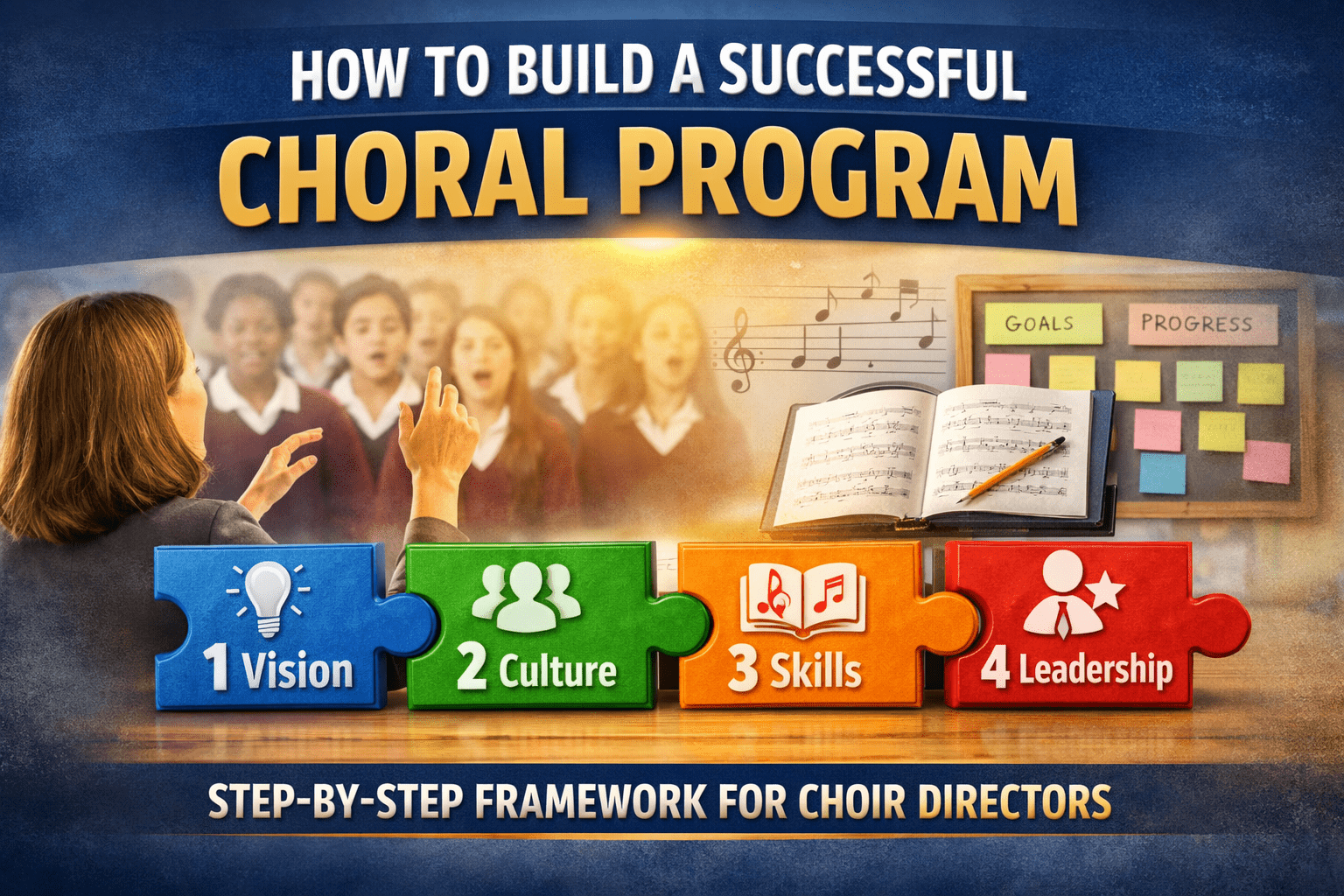
We help you build your program around a clear mission, then follow a step-by-step curriculum that keeps your focus aligned with the season you’re in—classroom culture and flow first, then skill development, then assessment, then leadership.
The result is that your transitions stop feeling random. They become anchored in your mission and supported by a structure you can rely on all year long.
If you want that kind of clarity and support, you can learn more or join here:
https://bit.ly/ChoralClarityCollective




Leave A Comment